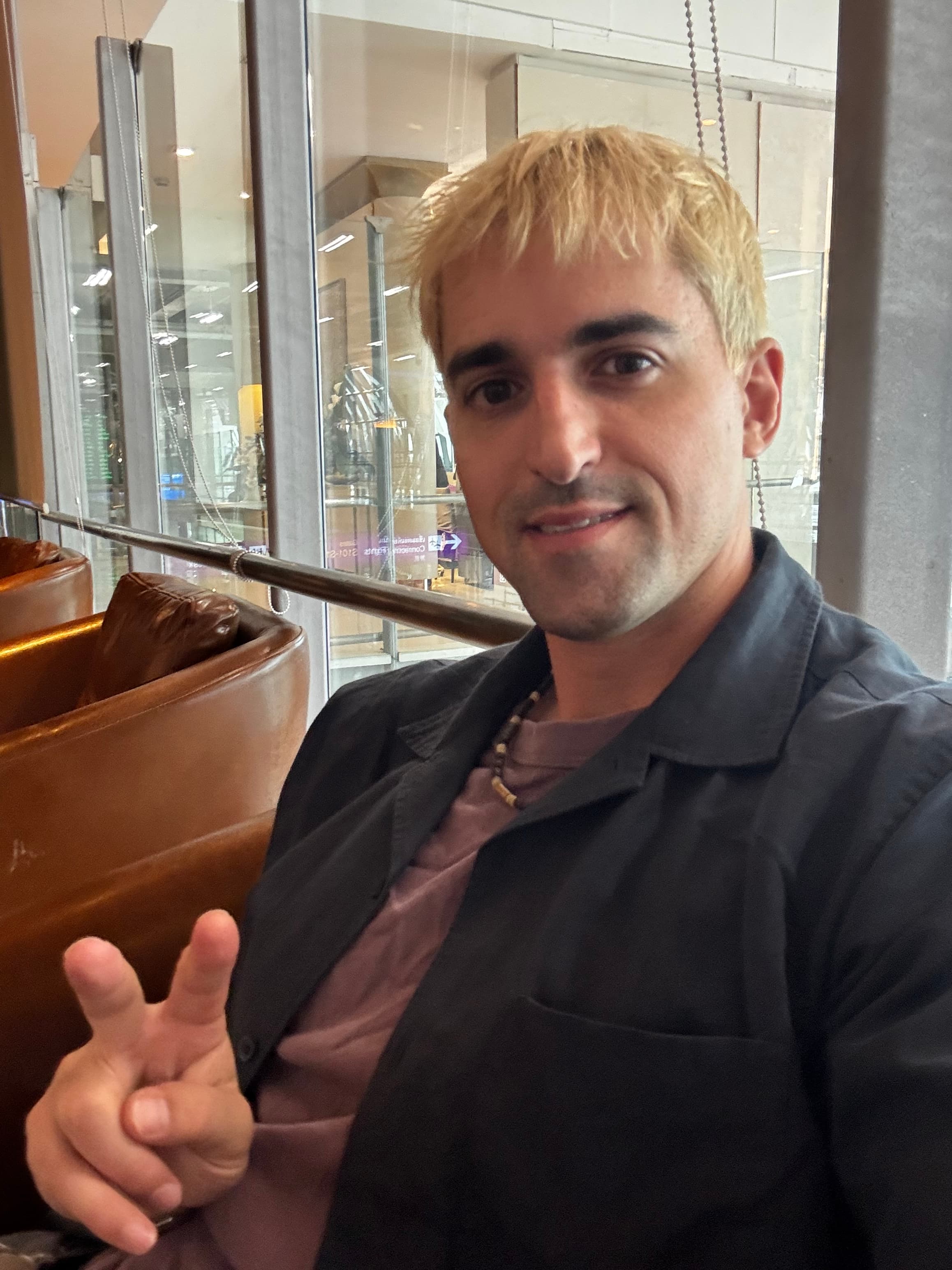
I'm a Master's student in Computer Science at UC San Diego, focused on ML systems, the software and infrastructure that make machine learning models efficient and usable. Lately that means sparse attention for long context LLMs, fused GPU kernels in Triton, and ML scientific tooling as DuckDB UDF extensions.
Before UC San Diego, I served six years in the U.S. Army in EOD and logistics, including leading a platoon that cleared more than 1,000 landmines and unexploded ordnance in South Korea. EOD gave me my first taste of deeply technical, multidimensional problems that reward ingenuity and contain tradeoffs. Software gives me that same challenge at lower stakes. After the Army, I moved into software engineering at Palo Alto Networks, where I led frontend integration of an AI copilot into Strata Cloud Manager. I came to UCSD to understand the systems beneath the software I was building.
Outside of that, I like running, paddle boarding and playing electric guitar. I'm currently into pop-punk, nu-metal and grunge.
PROJECTS
- Co-authored Double-P, a hierarchical sparse-attention method for long-context LLM inference. Analyzed top-k budgets and found they violated the top-p attention-mass criterion for over 20% of evaluated heads, motivating adaptive token budgets.
- Implemented zero copy FFI boundary in process memory sharing between C++ DuckDB User Defined Functions (UDF) and a Rust based Random Forest implementation via the Apache Arrow C Data Interface (ArrowArray / ArrowSchema).
- Implemented memory bounded in database TreeSHAP attribution streaming, dynamically deriving batch sizes to enforce a < 80 MB peak memory, computing an attribution double per sample, class and feature (197k sparse features) without OOMs, supporting browser WASM.
- Optimized sparse matrix scanning across 13M+ cells using DuckDB's UnifiedVectorFormat using std::string_view avoiding string materialization before interning as sparse COO representation. Used flat memory layouts and strides rather than Vec<Vec<Vec<f64>>> eliminating intermediate heap allocations and introducing cache line friendly access.
- Implemented and benchmarked a fused FP16 matrix multiplication, elementwise add, and ReLU kernel in Triton. Evaluated five tile configurations and achieved a 1.28× speedup over the PyTorch reference (0.265 ms vs. 0.339 ms) on an NVIDIA A10 for a 2048×2048×2048 workload.
- Reimplemented and pretrained a BiomeGPT BERT style feature tokenized transformer. Tested an Integrated Gradients baseline for feature tokenized transformer as Model vocab(species identity) + MLP(0 abundance) that resulted in a near 0 completeness delta compared to the all zero embedding baseline (0)^R{512}.
- Implemented cases in Loma's forward and reverse mode autodiff passes, extending existing intermediate representation (IR) mutators to transform program IR into first-order derivative compiled C functions.